

- 6-Minute Article
- |
- Oct 01, 2025
Build Retirement Confidence With Guaranteed Income and Learn How to Discuss It With Your Financial Professional
Explore how guaranteed income from an annuity can help support your goals.




- What are some examples of guaranteed income sources in retirement?
- How can my financial professional help me better understand my future Social Security benefits and how they compare to other guaranteed lifetime income options?
- What are questions I can ask my financial professional to gain a deeper understanding of my strategy for allocating a portion of my retirement portfolio to an annuity that provides guaranteed lifetime income?
You work hard and save diligently over the course of your career so you can enjoy the retirement you’ve planned and dreamed of. That’s why 97% of investors say that safeguarding their retirement assets is either moderately or very important.1 Rising health care costs, inflation, and market volatility can all impact your financial confidence. For many investors, having a higher percentage of their portfolio allocated to guaranteed lifetime income gives them more confidence to spend the money they’ve saved over the years.2
A Greater Allocation to Guaranteed Lifetime Income Could Allow Retirees to Spend More Confidently
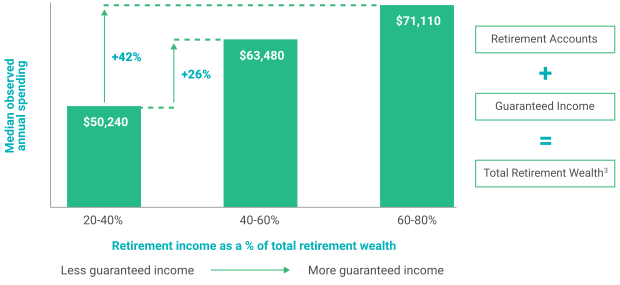
Source: Guide to Retirement. J.P. Morgan Asset Management, 2025.
For illustrative purposes only. Chase data, includes select Chase credit and debit card, electronic payment, ATM withdrawal, and check transactions in 2023. Information that would have allowed identification of specific customers was removed prior to the analysis. Asset estimates for de-identified and aggregated households supplied by IXI/Equifax, Inc. Total retirement wealth is the sum of investable wealth and the present value of observed retirement income sources, including Social Security (inflated) as well as pensions and annuities (both not inflated) until age 90. Inflation rate assumption is 2.5%. Observed retirement income sources are adjusted to pre-tax values to be consistent with investable wealth.
Sources of guaranteed lifetime income can provide a reliable stream of money no matter how long you live and can include:
- Social Security benefits
- Pension plan payments
- Payments from an annuity with guaranteed lifetime income

Certain annuities may also provide added benefits, such as some protection from market volatility and a death benefit for your beneficiaries.
In retirement, guaranteed income can be used to cover essential expenses like housing, food, and medical costs, allowing you to use the remainder of the money in your portfolio for travel, hobbies, or other discretionary expenses. Guaranteed income can also help mitigate the risk that poor market performance, combined with ongoing withdrawals from your portfolio, could cause you to run out of money sooner than expected. A source of guaranteed income may reduce the need to withdraw as much from the remainder of your portfolio, which can potentially make your savings last longer and help you feel more confident about your financial future.
With fewer private companies offering pension plans4 and the future of Social Security being uncertain,5 it’s important to have regular conversations with your financial professional about how your portfolio can generate additional sources of guaranteed income. Your financial professional can help guide you through guaranteed income options that are available to you, including understanding your strategy for claiming Social Security benefits and the benefits of different types of annuities. Additionally, allocating a portion of your retirement portfolio to products that offer guaranteed income can help cover essential expenses. This allows more of your assets to remain invested in the markets, giving them greater growth potential over time to help support a more resilient long-term strategy.
Key questions to help you feel more confident about your sources of retirement income
1. Are there components within my current financial portfolio that may provide a source of guaranteed income?
Why ask? This question starts a discussion about Social Security benefits, pensions, and any other forms of guaranteed income, such as an annuity held within a workplace retirement savings plan.
Follow-up question: If my portfolio is under-allocated to sources of guaranteed income, where would you recommend we begin to build a more balanced portfolio?
2. How much guaranteed income is needed for my desired lifestyle in retirement?
Why ask? Guaranteed income that covers your essential expenses may help you feel more confident to spend from the remainder of your portfolio to cover other retirement goals like travel, leaving a legacy for family, or supporting your favorite cause. Research shows that 51% of investors don’t believe they will have enough savings to last their lifetime and 32% of people aren’t confident that they’ll have enough money for regular monthly expenses throughout retirement.6
Follow-up question: If I have enough guaranteed income to cover my essential expenses, what changes can we make to the remainder of my portfolio to help me achieve other goals in retirement?
3. What is my projected Social Security benefit, and how does it change based on the age I begin claiming?
Why ask? Social Security benefits are a primary source of guaranteed income. And yet, a retirement income survey found that nearly 70% of non-retired investors have only some or no idea of the amount of income they’ll receive from their Social Security benefits in retirement.1 Understanding what your benefits may look like, depending on what age you retire, gives you a baseline for the amount of guaranteed income you may receive before exploring additional options.
Follow-up question: Based on my existing portfolio and retirement goals, should I delay claiming Social Security benefits?
4. Considering my current asset allocation, what would happen if the market experienced a downturn just before or within the first few years of my retirement?
Why ask? It’s important to understand sequence of returns risk – the impact that market conditions and withdrawals in the early years of your retirement can have on the long-term value of your portfolio. Understanding this risk can help you and your financial professional better assess your risk tolerance.
Follow-up question: If I increase the allocation to guaranteed income in my portfolio by purchasing an annuity that can provide lifetime income, how does that change my projections?
5. If an annuity is suitable for my needs, which type can help support my retirement goals and keep my portfolio on track?
Why ask? There has been innovation in the annuity market over the years, with companies offering several new types of annuities that may have benefits such as generally lower or no explicit annual fees, an opportunity for growth, a level of protection from market volatility, potentially higher income payments, and guaranteed lifetime income for you and a surviving spouse.
Follow-up question: Is there a specific type of annuity that could provide a greater benefit for me depending on whether I’m retiring in five years, 10 years, or more?
Taking the Next Step
Guaranteed lifetime income can be a valuable part of a plan for retirement, but it starts with a conversation. By asking questions and sharing your goals with your financial professional, you can work together to explore the right income options for your future, including whether adding guaranteed income from an annuity fits your needs.
- Share :